 |
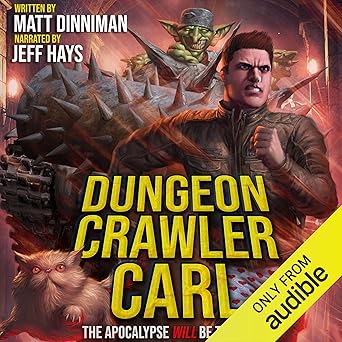
| Dungeon Crawler Carl Cover Art |
NEW ACHIEVEMENT: You found a book that sounds utterly ridiculous on paper and somehow turns out to be one of the most entertaining, emotionally effective, and unexpectedly addictive audiobooks you’ve listened to in years. Reward: existential dread, uncontrollable laughter, and a sudden urge to explain loot tables to confused friends.
Dungeon Crawler Carl by Matt Dinniman is an absolute riot from beginning to end. The premise feels like it was engineered in a laboratory to sound absurd. Earth is destroyed by an alien corporation, the survivors are forced into a galaxy wide reality television death game, and our protagonist must descend through an increasingly deadly dungeon accompanied by his ex-girlfriend’s prize-winning cat. It should be nonsense. In many ways it is nonsense. It is also brilliantly written, consistently hilarious, surprisingly brutal, and far more emotionally engaging than I ever expected.
At the centre of the chaos is Carl, who could easily have been written as a generic sarcastic action hero. Instead, he feels refreshingly human. He is bewildered, angry, frequently out of his depth, and often making decisions based on stubbornness and sheer survival instinct. His growing relationship with Princess Donut, who rapidly evolves from comic relief into one of the most entertaining characters in the book, becomes one of the novel’s greatest strengths. Their dynamic is genuinely funny, but it also develops real emotional depth as the story progresses.
What immediately stands out is how perfectly the book captures the feel of both MMORPGs and tabletop roleplaying games. Anyone who has spent far too many hours in World of Warcraft, Diablo, Final Fantasy XIV, or similar games will instantly recognise the mechanics. Loot drops, increasingly absurd item descriptions, skill trees, dungeon bosses, party management, crafting systems, min maxing, grinding, and wildly unbalanced encounters are all lovingly mocked while still feeling like genuine celebrations of gaming culture.
The tabletop influences are just as strong. There is a heavy Dungeons & Dragons energy running through the entire novel, particularly in the way absurd encounters can spiral into unexpected chaos because of player choices. It often feels like a dungeon master who has completely lost control of their campaign while the players somehow continue succeeding through luck, creativity, and reckless decision making. That chaotic energy gives the story an unpredictability that makes it incredibly difficult to stop listening.
What surprised me most was how dark the story becomes beneath the humour. The alien entertainment system at the heart of the dungeon is deeply disturbing, and Dinniman never lets the reader forget the human cost of the spectacle. Characters die horribly. People break under pressure. The satire of reality television and corporate exploitation becomes increasingly sharp as the story unfolds.
The audiobook is elevated to another level entirely by the phenomenal narration of Jeff Hays. This is genuinely one of the best audiobook performances I have ever heard. Hays does not simply narrate the story. He performs it with extraordinary energy, emotional range, and comedic precision.
His portrayal of Carl perfectly captures the character’s frustration, sarcasm, and vulnerability. More impressively, his performance as Princess Donut is extraordinary. He gives her a larger than life personality that could easily become irritating, yet somehow makes her endlessly entertaining. Her dramatic declarations are consistently hilarious.
Hays also handles the dungeon AI announcements, bizarre monsters, and enormous supporting cast with astonishing versatility. Every voice feels distinct and memorable. More importantly, he understands when to let the humour breathe and when to lean into the darker emotional moments. That balance is what makes the performance truly exceptional.
By the end, I was stunned by how much I loved this book. Dungeon Crawler Carl is clever, chaotic, heartfelt, and relentlessly entertaining. It embraces absurdity while delivering genuine stakes and surprisingly rich character development. Combined with Jeff Hays’ spectacular narration, this became one of the most enjoyable audiobook experiences I have had in a very long time.
Buy your copy here
-Horizontal.jpg)