Showing posts with label Sci-fi. Show all posts

Sunday, 17 May 2026

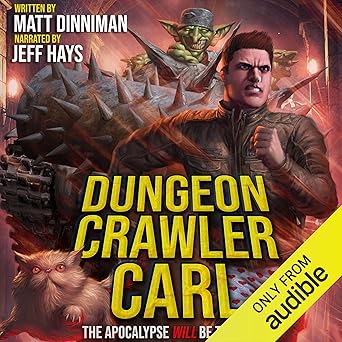
Review: Dungeon Crawler Carl

Dungeon Crawler Carl Cover Art

NEW ACHIEVEMENT: You found a book that sounds utterly ridiculous on paper and somehow turns out to be one of the most entertaining, emotionally effective, and unexpectedly addictive audiobooks you’ve listened to in years. Reward: existential dread, uncontrollable laughter, and a sudden urge to explain loot tables to confused friends.

Dungeon Crawler Carl by Matt Dinniman is an absolute riot from beginning to end. The premise feels like it was engineered in a laboratory to sound absurd. Earth is destroyed by an alien corporation, the survivors are forced into a galaxy wide reality television death game, and our protagonist must descend through an increasingly deadly dungeon accompanied by his ex-girlfriend’s prize-winning cat. It should be nonsense. In many ways it is nonsense. It is also brilliantly written, consistently hilarious, surprisingly brutal, and far more emotionally engaging than I ever expected.

At the centre of the chaos is Carl, who could easily have been written as a generic sarcastic action hero. Instead, he feels refreshingly human. He is bewildered, angry, frequently out of his depth, and often making decisions based on stubbornness and sheer survival instinct. His growing relationship with Princess Donut, who rapidly evolves from comic relief into one of the most entertaining characters in the book, becomes one of the novel’s greatest strengths. Their dynamic is genuinely funny, but it also develops real emotional depth as the story progresses.

What immediately stands out is how perfectly the book captures the feel of both MMORPGs and tabletop roleplaying games. Anyone who has spent far too many hours in World of Warcraft, Diablo, Final Fantasy XIV, or similar games will instantly recognise the mechanics. Loot drops, increasingly absurd item descriptions, skill trees, dungeon bosses, party management, crafting systems, min maxing, grinding, and wildly unbalanced encounters are all lovingly mocked while still feeling like genuine celebrations of gaming culture.

The tabletop influences are just as strong. There is a heavy Dungeons & Dragons energy running through the entire novel, particularly in the way absurd encounters can spiral into unexpected chaos because of player choices. It often feels like a dungeon master who has completely lost control of their campaign while the players somehow continue succeeding through luck, creativity, and reckless decision making. That chaotic energy gives the story an unpredictability that makes it incredibly difficult to stop listening.

What surprised me most was how dark the story becomes beneath the humour. The alien entertainment system at the heart of the dungeon is deeply disturbing, and Dinniman never lets the reader forget the human cost of the spectacle. Characters die horribly. People break under pressure. The satire of reality television and corporate exploitation becomes increasingly sharp as the story unfolds.

The audiobook is elevated to another level entirely by the phenomenal narration of Jeff Hays. This is genuinely one of the best audiobook performances I have ever heard. Hays does not simply narrate the story. He performs it with extraordinary energy, emotional range, and comedic precision.

His portrayal of Carl perfectly captures the character’s frustration, sarcasm, and vulnerability. More impressively, his performance as Princess Donut is extraordinary. He gives her a larger than life personality that could easily become irritating, yet somehow makes her endlessly entertaining. Her dramatic declarations are consistently hilarious.

Hays also handles the dungeon AI announcements, bizarre monsters, and enormous supporting cast with astonishing versatility. Every voice feels distinct and memorable. More importantly, he understands when to let the humour breathe and when to lean into the darker emotional moments. That balance is what makes the performance truly exceptional.

By the end, I was stunned by how much I loved this book. Dungeon Crawler Carl is clever, chaotic, heartfelt, and relentlessly entertaining. It embraces absurdity while delivering genuine stakes and surprisingly rich character development. Combined with Jeff Hays’ spectacular narration, this became one of the most enjoyable audiobook experiences I have had in a very long time.

Buy your copy here

Thursday, 14 May 2026

Review: Dragondrums

Dragondrums Cover Art
Dragondrums by Anne McCaffrey holds a particularly special place in my memory because it was the very first Dragonriders of Pern novel I ever read as a child. Long before I understood the wider chronology of the series or fully appreciated the depth of McCaffrey’s world building, this was my introduction to Pern. Revisiting it now as an adult carried a unique sense of nostalgia. I was returning not just to a novel, but to the doorway that first introduced me to one of my favourite fictional worlds.

That personal connection made the reread especially interesting because Dragondrums feels quite different when approached with adult eyes. As a child, I was immediately captivated by the dragons, fire lizards, Harper Hall politics, and the simple thrill of discovering a world that felt so vast and lived in. Those elements remain deeply enjoyable, but what stood out to me now was how thoughtful and character driven this novel really is.

Unlike Dragonsong and Dragonsinger, which focus on Menolly’s struggles to find acceptance and recognition, Dragondrums shifts its attention to Piemur. He had always been an entertaining supporting character in my childhood memory, largely because of his humour, confidence, and occasional talent for causing chaos. Revisiting the novel now, I found him far more layered than I remembered. His frustration over the loss of his singing voice feels genuinely painful, particularly because music had defined so much of his identity.

McCaffrey handles that transition exceptionally well. Piemur’s bitterness, embarrassment, and eventual adaptation all feel believable. He does not immediately embrace his new role, and his resentment is understandable. Watching him slowly realise that his talents extend far beyond singing creates a compelling emotional arc. His intelligence, curiosity, and ability to navigate difficult situations become increasingly important, and his growth feels earned rather than forced.

One of the most enjoyable aspects of the novel remains its sense of adventure. Piemur’s increasingly dangerous assignments and secretive tasks add momentum to the story, creating moments of tension that balance the more reflective character development. These sections remain highly entertaining and capture much of the excitement that first drew me into the series as a child.

The world building remains one of McCaffrey’s greatest strengths. By this point, Pern feels fully realised, with its social hierarchies, traditions, and evolving political tensions all contributing to the sense of a living world. Because this was my first introduction to Pern as a child, I remember feeling overwhelmed in the best possible way by how large everything seemed. Returning to it now, I was struck by how efficiently McCaffrey introduces these elements without overwhelming the reader.

The relationships between characters also feel richer than I remembered. Menolly remains a strong presence, and her friendship with Piemur adds warmth to the story. Their interactions feel genuine and supportive, helping ground the larger narrative in personal relationships.

The audiobook is significantly enhanced by the narration of Sally Darling. Darling once again proves herself an excellent match for this corner of the Pern universe. Her narration carries genuine warmth and emotional depth, particularly during Piemur’s more vulnerable moments.

She captures his frustration and insecurity with real sensitivity while also embracing his mischievous energy. That balance is essential to making Piemur as engaging as he is, and Darling handles it beautifully. Her performance ensures that his humour never undermines the more serious emotional beats.

Darling’s pacing is excellent throughout. She allows quieter moments of reflection to land while maintaining tension during the more adventurous sequences. Her character voices remain distinct without becoming exaggerated, helping preserve the grounded emotional tone of the novel.

Revisiting Dragondrums was both nostalgic and genuinely rewarding. There was a risk that the first Pern novel I ever read might feel diminished by time and memory, but the opposite proved true. The story remains engaging, emotionally honest, and full of charm.

While nostalgia certainly shaped my return to this book, it also reminded me why Anne McCaffrey’s world captured my imagination so completely as a child. Dragondrums remains a wonderful entry point into Pern and a deeply satisfying novel in its own right. With Sally Darling’s heartfelt narration adding even more emotional texture, this revisit felt like reconnecting with an old friend.

Buy your copy here

Sunday, 10 May 2026

Review: Dragonsinger

Dragonsinger Cover Art

Dragonsinger by Anne McCaffrey was one of those novels that lived vividly in my memory from childhood, even if many of the finer details had faded over time. Returning to it now for the first time in decades was both a nostalgic experience and an unexpectedly rewarding one. There is always a degree of risk when revisiting books that meant a great deal to you when you were younger. Sometimes they do not hold up in quite the way you hope. Thankfully, Dragonsinger not only survives that revisit, but in many ways feels richer and more emotionally resonant when read as an adult.

Picking up shortly after the events of Dragonsong, the novel follows Menolly as she leaves the restrictive environment of Half-Circle Sea Hold and begins life at Harper Hall. After spending so much of the previous book watching her talents be dismissed or actively suppressed, there is something deeply satisfying about seeing her enter a space where her musical gifts can finally be nurtured. That does not mean her journey suddenly becomes easy. McCaffrey wisely avoids making Harper Hall an idealised sanctuary, and Menolly quickly discovers that jealousy, hierarchy, and entrenched attitudes still create significant obstacles.

What makes the novel so effective is the way it balances external conflict with quieter emotional development. The dramatic tension here is far less about life threatening danger and more about belonging, confidence, and self worth. Menolly remains an immensely likeable protagonist because she never transforms into an effortlessly confident hero. She continues to doubt herself, struggles with loneliness, and often feels overwhelmed by the expectations placed upon her. Those insecurities make her triumphs feel genuinely earned.

Revisiting the novel as an adult, I found myself appreciating these emotional beats far more than I did as a child. When I first read Dragonsinger, I was naturally drawn to the fire lizards, the music, and the wider sense of adventure. Those aspects remain delightful. The fire lizards are still wonderfully charming, often providing moments of humour and warmth, and McCaffrey’s descriptions of music retain a sense of passion that makes Menolly’s gift feel tangible.

What stood out much more this time was the social complexity of Harper Hall. The rivalries between apprentices, the insecurities of those who feel threatened by Menolly’s talent, and the institutional traditions that shape behaviour all feel more nuanced than I remembered. McCaffrey does an excellent job of portraying how progress often happens unevenly. Menolly may have escaped one form of restriction, but she still has to navigate people who are resistant to change.

The world of Pern continues to feel wonderfully immersive. One of McCaffrey’s greatest strengths has always been making the setting feel lived in. The halls, holds, and traditions all possess a sense of history, and even smaller moments help reinforce that depth. Dragonsinger may be more intimate in scale than some of the larger Pern novels, but that narrower focus allows the world building to feel particularly personal.

The audiobook is elevated significantly by the narration of Sally Darling. Darling delivers a wonderfully warm and emotionally intelligent performance that feels perfectly suited to Menolly’s story. Her narration captures the protagonist’s vulnerability without ever making her seem weak, and she handles moments of triumph with genuine warmth.

There is a real emotional sensitivity in Darling’s performance that strengthens the quieter scenes. Moments of embarrassment, isolation, and joy all feel authentic because she allows them space to breathe. Her portrayal of supporting characters is equally effective, creating clear distinctions without becoming exaggerated or theatrical.

Her pacing is particularly strong during scenes involving music. She manages to communicate the emotional importance of these moments in a way that feels natural and heartfelt. That is no small achievement in a story where music is so central to the protagonist’s identity.

Returning to Dragonsinger after so many years reminded me why Anne McCaffrey’s work left such a lasting impression on me as a child. It remains a thoughtful, heartfelt coming of age story wrapped in a richly realised fantasy world. While nostalgia certainly played a role in my enjoyment, the novel’s emotional honesty and enduring charm proved that my childhood affection for it was entirely deserved. Combined with Sally Darling’s excellent narration, this was a genuinely rewarding revisit.

Buy your copy here

Thursday, 7 May 2026

Review: Dragonsong

Dragonsong Cover Art

Dragonsong by Anne McCaffrey was one of those formative books I encountered as a child, the kind of novel that quietly embeds itself in your imagination and remains there for decades. Returning to it now for the first time since childhood was a fascinating experience, not simply because of nostalgia, but because I found myself responding to the story in very different ways as an adult. What once felt like a straightforward tale of adventure and self discovery now reveals deeper themes about autonomy, gender expectations, and resilience that I simply did not have the perspective to fully appreciate when I first read it.

The story follows Menolly, a gifted young woman living in a small fishing hold on Pern, where her musical talent is dismissed and actively suppressed because of rigid social expectations surrounding what women should and should not do. After an injury threatens her ability to play music and her family continues to stifle her ambitions, Menolly flees and carves out a life for herself in isolation, eventually forming a remarkable bond with a group of fire lizards.

As a child, I remember being captivated by the dragons, the fire lizards, and Menolly’s independence. Those elements remain every bit as compelling today. McCaffrey’s world building is as immersive as ever, and Pern still feels wonderfully unique in the way it blends science fiction foundations with the aesthetics of fantasy. The natural ecosystem, social structures, and traditions all feel lived in, and Dragonsong serves as a particularly effective entry point into that wider world.

What struck me far more on this reread, however, were the themes of patriarchy and misogyny that shape Menolly’s life. As a child, I understood that she was being treated unfairly, but I lacked the life experience to fully appreciate how insidious those attitudes were. Reading it as an adult, the restrictions placed on her feel far more frustrating and sadly recognisable. Her father’s rigid beliefs, her mother’s internalised acceptance of those beliefs, and the wider social norms of her community create an environment that feels suffocatingly believable.

What makes the novel so effective is that McCaffrey never allows these themes to overwhelm the sense of wonder at the heart of the story. Menolly’s struggle is painful, but it is also deeply empowering. Her journey towards self worth feels earned because it emerges through perseverance rather than sudden transformation. She remains vulnerable, frightened, and uncertain throughout much of the story, which makes her eventual growth all the more satisfying.

The emotional heart of the audiobook is strengthened enormously by the narration of Sally Darling. Darling delivers a performance filled with warmth and emotional nuance that perfectly suits Menolly’s story. Her narration captures the protagonist’s vulnerability during moments of rejection and loneliness, while also conveying her growing confidence as she begins to recognise her own worth.

Darling’s performance is especially effective in scenes involving Menolly’s music. She communicates the emotional significance of these moments with genuine tenderness, helping the listener understand why music means so much to the character. Her pacing allows quieter emotional beats to land effectively, and she handles the wider cast with clarity and subtle distinction.

There is also a sincerity to Darling’s narration that complements the novel’s emotional core. She never overplays dramatic moments, instead allowing the feelings already present in McCaffrey’s writing to emerge naturally. That restraint makes the audiobook feel deeply intimate.

Revisiting Dragonsong after so many years could easily have been disappointing. Childhood favourites do not always survive adult scrutiny. Instead, I found a richer and more emotionally layered story than I remembered. The adventure remains delightful, the world of Pern remains captivating, and Menolly remains an inspiring protagonist.

What changed was my understanding of the themes beneath the surface, and that only deepened my appreciation. Combined with Sally Darling’s heartfelt narration, Dragonsong proved to be both a nostalgic return and a genuinely rewarding new experience. It remains a deserved classic and one of Anne McCaffrey’s most enduringly powerful works.

Buy your copy here

Monday, 13 April 2026

Review: A Wrinkle in Time

A Wrinkle in Time Cover Art

A Wrinkle in Time by Madeleine L'Engle remains a landmark of imaginative children’s literature, blending science fiction, fantasy, and philosophical reflection into a story that continues to resonate across generations. It is a novel that invites readers to embrace curiosity, courage, and individuality, all while exploring concepts that feel surprisingly expansive for a book of its size.

At its heart, the story follows Meg Murry, a young girl struggling with self doubt and a sense of not fitting in, as she embarks on an extraordinary journey across space and time. Accompanied by her gifted younger brother Charles Wallace and their friend Calvin, Meg is drawn into a mission to rescue her father from a dark and oppressive force. The narrative unfolds with a dreamlike logic, moving between familiar domestic settings and strange, otherworldly environments that challenge both the characters and the reader.

One of the novel’s greatest strengths lies in its sense of wonder. L’Engle introduces complex ideas such as tesseracts, higher dimensions, and the nature of good and evil in a way that feels accessible without being simplistic. The world building is imaginative and distinctive, with each new location offering its own atmosphere and underlying philosophy. From the warmth of Mrs Whatsit, Mrs Who, and Mrs Which to the unsettling uniformity of Camazotz, the settings are vivid and memorable.

The depth of character is equally notable. Meg is an especially compelling protagonist because of her flaws. She is often impatient, uncertain, and prone to anger, yet these qualities make her growth feel genuine. Her journey is not just about travelling through space but about learning to trust herself and accept her own worth. Charles Wallace, with his precocious intelligence, and Calvin, with his quiet empathy, provide strong contrasts that enrich the emotional dynamics of the story.

The audiobook presentation adds another dimension to this already rich narrative. The inclusion of multiple narrators, including Hope Davis, Ava DuVernay, and Charlotte Jones Voiklis, creates a layered and engaging listening experience. Each voice brings a slightly different texture to the story, reflecting its shifting tones and perspectives.

Hope Davis provides a grounded and expressive narration that captures Meg’s emotional journey with sensitivity. Her delivery conveys both the vulnerability and determination of the character, making it easy to connect with Meg’s struggles and triumphs. Ava DuVernay’s contributions add a sense of clarity and gravitas, particularly in passages that touch on the novel’s broader themes. Her voice lends weight to the more philosophical elements of the text, helping to emphasise its enduring relevance. Charlotte Jones Voiklis, as L’Engle’s granddaughter, brings a personal connection to the material that feels both respectful and intimate. Her narration carries a warmth that complements the story’s underlying message of love and resilience.

Together, this ensemble approach enhances the storytelling rather than distracting from it. The shifts between narrators are handled smoothly, and the variation in tone keeps the listening experience fresh. It feels almost as though the story is being passed between voices, echoing its themes of connection and shared understanding.

What makes A Wrinkle in Time so enduring is its willingness to engage with big ideas while remaining deeply human. It explores darkness and conformity without losing sight of hope and individuality. The narrative may at times feel unconventional in its structure, but this only adds to its charm, reinforcing the sense that the universe it depicts operates beyond ordinary rules.

Overall, this is a beautifully imaginative and emotionally resonant work that continues to captivate new audiences. With its rich world building, memorable characters, and the added dimension of a thoughtfully performed audiobook, A Wrinkle in Time stands as a timeless and rewarding experience.

Buy your copy here

Friday, 10 April 2026

Review: The Player of Games

The Player of Games Cover Art

The Player of Games by Iain M. Banks is a superb continuation of the Culture series, refining and deepening many of the ideas introduced in Consider Phlebas while offering a more focused and character driven narrative. It is a novel that combines intellectual intrigue with rich world building, resulting in a story that is both engaging and quietly thought provoking.

At the centre of the novel is Jernau Morat Gurgeh, a master game player from the Culture, a civilisation defined by its post scarcity abundance and reliance on advanced artificial intelligences. Gurgeh’s life is one of comfort and prestige, yet it is also marked by a certain restlessness. When he is invited to take part in a complex and politically significant game in the Empire of Azad, he accepts, setting in motion a journey that challenges not only his skills but his understanding of himself and the societies around him.

The depth of character in the novel is one of its greatest strengths. Gurgeh is not a traditional hero, but he is deeply compelling. His confidence, pride, and occasional moral uncertainty make him feel fully realised. As the story progresses, his reactions to new experiences and increasing pressure reveal layers of vulnerability beneath his composed exterior. Supporting characters, including both humans and artificial intelligences, are equally well drawn. Banks has a remarkable ability to convey personality through dialogue and subtle detail, giving even minor figures a sense of presence.

World building is handled with similar care. The Culture itself is presented in greater detail here, offering a clearer picture of its values and internal dynamics. At the same time, the Empire of Azad provides a striking contrast. Its rigid hierarchy, competitive ethos, and the central role of the game that defines its society create a setting that feels both alien and disturbingly familiar. Banks uses this contrast to explore themes of power, control, and the ways in which systems of competition can shape entire cultures.

The complexity of the story lies not only in its plot but in the ideas it engages with. The game of Azad is more than a simple contest. It is a reflection of the empire’s political and social structure, with each move carrying symbolic and practical consequences. As Gurgeh progresses through the tournament, the narrative becomes increasingly layered, blending strategy, psychological tension, and political intrigue. Banks manages to convey the significance of the game without overwhelming the reader with technical detail, maintaining a balance between accessibility and depth.

The audiobook is greatly enhanced by the narration of Peter Kenny. Kenny delivers a performance that captures both the intellectual tone of the novel and its underlying emotional currents. His portrayal of Gurgeh reflects the character’s confidence and gradual transformation, while his handling of other voices ensures that each character remains distinct and recognisable.

Kenny’s pacing is particularly effective in a story that alternates between moments of quiet reflection and intense competition. He allows the tension of the game sequences to build naturally, giving the listener time to absorb the stakes involved. At the same time, his delivery of the novel’s more contemplative passages adds weight to the themes being explored.

Overall, The Player of Games is a richly rewarding novel that showcases Iain M. Banks at his best. It combines strong character work, detailed world building, and a narrative that is both intellectually and emotionally engaging. With Peter Kenny’s excellent narration bringing the story to life, the audiobook offers an immersive experience that highlights the depth and complexity of this outstanding work of science fiction.

Buy you copy here

Sunday, 5 April 2026

Review: Consider Phlebas

Consider Phlebas Cover Art
Consider Phlebas by Iain M. Banks is a bold and ambitious introduction to the Culture series, one that immediately establishes the scale, complexity, and philosophical depth that would come to define Banks’ science fiction. Rather than easing the reader into this universe, the novel immerses you in the middle of a vast interstellar conflict, trusting you to find your footing as the story unfolds.

Set during a war between the Culture and the Idiran Empire, the novel follows Bora Horza Gobuchul, a shape changing mercenary who finds himself aligned against the Culture. This choice of protagonist is one of the book’s most interesting aspects. By focusing on a character who opposes what is often presented as a utopian civilisation, Banks invites the reader to question assumptions about morality, progress, and power. Horza is not an easy hero to embrace, but he is compelling. His motivations, loyalties, and contradictions give the narrative a strong emotional anchor.


The depth of character throughout the novel is impressive. Even secondary figures are given enough detail to feel distinct and believable. Banks has a talent for suggesting entire lives and histories with relatively small amounts of text, which contributes to the sense that this universe extends far beyond the immediate story. Characters react to danger, loss, and shifting alliances in ways that feel grounded and human, even within the novel’s far future setting.

World building is where Consider Phlebas truly excels. The Culture itself is only glimpsed from the outside for much of the story, yet it feels vast and fully realised. Its post scarcity society, governed in large part by advanced artificial intelligences, stands in stark contrast to the more rigid and hierarchical Idiran Empire. Beyond these two major powers, the novel introduces a wide range of locations, species, and technologies, each adding another layer to the setting. From orbital habitats to derelict structures drifting in space, every environment feels carefully imagined.

The complexity of the story is both a strength and, at times, a challenge. The narrative moves through a series of episodes that can feel almost self contained, yet they gradually build towards a larger conclusion. There are moments of intense action, quieter passages of reflection, and sudden shifts in tone that keep the reader on edge. This structure reinforces the unpredictability of the universe Banks has created, though it does require a degree of patience and attention to fully appreciate how the pieces fit together.

The audiobook is greatly enhanced by the narration of Peter Kenny. Kenny brings clarity and energy to a text that could easily become overwhelming. His ability to differentiate characters helps guide the listener through the novel’s many perspectives, and his pacing ensures that even the more complex sections remain engaging.

Kenny also captures the tonal shifts of the story effectively. He handles action sequences with urgency, while giving quieter moments the space they need to resonate. His narration adds a sense of cohesion to the episodic structure, helping the story feel more unified as it progresses.

Overall, Consider Phlebas is a challenging but rewarding read. It offers rich characterisation, expansive world building, and a story that is unafraid to embrace complexity. With Peter Kenny’s strong narration bringing the text to life, the audiobook becomes an accessible and immersive way to experience one of the most distinctive works in modern science fiction.

Buy your copy here

Monday, 30 March 2026

Review: Project Hail Mary

Project Hail Mary Cover Art (Movie Tie In)

Project Hail Mary by Andy Weir is an ambitious, inventive, and deeply entertaining science fiction novel that combines hard science with an engaging sense of humour and a surprisingly emotional core. Best known for The Martian, Weir once again proves his ability to take complex scientific ideas and present them in a way that feels accessible, suspenseful, and often genuinely moving. This is a story that thrives on curiosity, problem solving, and the resilience of an ordinary individual placed in extraordinary circumstances.

The novel opens with a compelling mystery. Ryland Grace awakens alone on a spacecraft with no memory of who he is or how he got there. As fragments of his memory begin to return, both the character and the reader are drawn into a gradually unfolding narrative that reveals the true scale of the crisis. Earth is facing an extinction level threat, and Grace may be humanity’s last hope. This dual structure, alternating between present day problem solving and reconstructed memories, creates a strong sense of momentum. Each revelation adds context and raises new questions, keeping the reader fully engaged.

One of the most effective aspects of the novel is its central character. Ryland Grace is not a traditional heroic figure. He is, in many ways, an unwilling participant in the mission that has placed him so far from home. His reluctance, self doubt, and occasional fear make him feel authentic and relatable. Rather than charging forward with unwavering confidence, he hesitates, questions his own capabilities, and often reacts to events with a mixture of anxiety and reluctant determination. This makes his eventual actions far more compelling. The story is not about a flawless saviour but about an ordinary person rising to meet an extraordinary challenge, often against his own instincts.

Weir’s approach to science is once again central to the novel’s appeal. The book is filled with detailed explanations of physics, biology, and engineering, yet these never feel like distractions from the story. Instead, they are woven into the narrative as part of the problem solving process. Each obstacle that Grace encounters requires careful thought, experimentation, and adaptation. The solutions are rarely straightforward, and the process of arriving at them becomes a source of tension in its own right. This emphasis on logical reasoning and incremental progress gives the story a satisfying sense of realism, even when dealing with highly speculative concepts.

At the same time, Project Hail Mary is not purely a technical exercise. It has a strong emotional thread that develops as the story progresses. Relationships, both remembered and newly formed, play a crucial role in shaping Grace’s journey. Without revealing too much, the novel introduces a dynamic that adds warmth, humour, and genuine poignancy to the narrative. This element elevates the story beyond a simple survival tale and gives it lasting emotional impact.

The pacing of the novel is another of its strengths. Weir balances moments of intense problem solving with quieter scenes of reflection and character development. The tension rises and falls in a way that keeps the reader engaged without becoming exhausting. Just as one challenge is resolved, another emerges, often more complex than the last. This constant escalation ensures that the stakes remain high throughout the narrative.

The audiobook experience is significantly enhanced by the narration of Ray Porter. Porter delivers a performance that captures both the humour and the vulnerability of Ryland Grace. His conversational style suits the first person narrative perfectly, making it feel as though the listener is inside Grace’s thoughts as he works through each problem.

Porter’s timing is particularly effective in conveying the character’s personality. Grace’s internal monologue is filled with dry observations, moments of panic, and flashes of insight, and Porter handles these shifts with ease. He allows the humour to land naturally while also giving weight to the more serious and emotional moments. This balance is crucial in a story that moves between scientific explanation and personal reflection.

Another notable aspect of Porter’s narration is his ability to convey tension. During scenes where Grace is racing against time to solve a problem, Porter subtly increases the pace and intensity of his delivery. This creates a sense of urgency that mirrors the character’s situation. At the same time, he knows when to slow down, allowing key moments to resonate.

Ultimately, Project Hail Mary succeeds because it brings together compelling character work, inventive science fiction concepts, and a strong narrative structure. The reluctant hero at its centre provides an emotional anchor that makes the story accessible and engaging, while the scientific challenges offer intellectual satisfaction.

With Ray Porter’s excellent narration bringing the story vividly to life, the audiobook becomes an immersive and highly enjoyable experience. This is a novel that combines excitement, humour, and heart in equal measure, resulting in a science fiction adventure that is both thought provoking and deeply entertaining.

Buy your copy here

Wednesday, 11 March 2026

Review: Not Till We Are Lost

Not Till We Are Lost Cover Art

Not Till We Are Lost by Dennis E. Taylor continues the ever expanding Bobiverse saga with confidence, humour, and a growing sense of philosophical depth. By this stage in the series, Taylor has created a remarkably rich setting in which artificial minds, human colonies, alien mysteries, and technological ingenuity all intersect. What makes this particular instalment so compelling is the way it balances those grand science fiction ideas with a continued focus on the personalities and evolving identities of the many Bob clones who inhabit the narrative.

The central premise of the Bobiverse remains delightfully imaginative. Bob Johansson, once a software engineer on Earth, now exists as a replicated digital consciousness controlling self replicating space probes. Over time these probes have spread across the galaxy, creating countless versions of Bob. Each new copy begins with the same core memories but gradually develops its own interests, quirks, and priorities. In Not Till We Are Lost, this divergence becomes an increasingly important part of the story.

The novel explores a galaxy that is now far more populated and politically complex than in earlier books. Human colonies have taken root in multiple systems, and the Bobs continue to serve as explorers, engineers, protectors, and sometimes reluctant mediators between competing factions. At the same time, the Bobs themselves are beginning to fragment ideologically. Some remain deeply invested in supporting humanity’s expansion, while others are more interested in pursuing pure exploration or experimenting with new forms of existence. This tension adds an intriguing layer of uncertainty to the narrative.

Taylor’s strength has always been his ability to introduce sophisticated scientific ideas without losing the sense of adventure that makes the series so enjoyable. That skill is very much on display here. The novel continues to explore concepts such as artificial intelligence, interstellar travel, and megastructures while also raising more personal questions about identity and purpose. If a copy of a mind evolves far enough from its original template, is it still the same person? And what responsibilities does that being have toward its origins?

Despite these philosophical undertones, the story never becomes heavy or abstract. The humour that has defined the Bobiverse from the beginning remains a constant presence. Conversations between the Bobs are filled with friendly sarcasm, pop culture references, and occasional exasperation as they debate the best course of action. These exchanges give the narrative a warm and conversational tone that keeps even the most complex discussions engaging.

The pacing of the novel also deserves praise. Taylor moves confidently between multiple plotlines, each involving different groups of Bobs and human allies confronting new challenges. Some threads focus on exploration and discovery, while others involve political tensions between colonies or encounters with unfamiliar alien phenomena. The variety keeps the story fresh and reinforces the sense that the Bobiverse is a living, evolving setting rather than a static backdrop.

The audiobook benefits enormously from the narration of Ray Porter, whose voice has become synonymous with the series. Porter brings a natural charm and intelligence to the role, capturing Bob Johansson’s blend of curiosity, wit, and occasional frustration perfectly. His delivery feels conversational and relaxed, which matches the tone of Taylor’s writing beautifully.

Narrating a story that features dozens of variations of the same character could easily become confusing, yet Porter handles it with remarkable skill. Each Bob sounds recognisable as part of the same origin while still possessing subtle differences in tone and cadence. These distinctions help listeners keep track of the many perspectives without losing the sense that they all began as the same individual.

Porter’s pacing is another major strength. The Bobiverse novels frequently shift between technical explanations, humorous exchanges, and moments of tension. Porter manages these transitions smoothly, allowing the science to remain accessible while ensuring that dramatic scenes retain their impact. His timing also enhances the humour, delivering many of the Bobs’ dry observations with impeccable comedic rhythm.

Ultimately, Not Till We Are Lost stands as another strong entry in the Bobiverse series. It expands the scope of the setting while continuing to explore the personal evolution of its central character in all his many forms. The combination of inventive science fiction concepts, engaging dialogue, and thoughtful themes makes the novel both entertaining and intellectually stimulating.

With Ray Porter once again providing a superb narration that captures every nuance of Taylor’s writing, the audiobook becomes an especially rewarding experience. For fans of the series, this instalment offers both fresh adventures and deeper insight into what it truly means to be Bob in a galaxy that is growing more complicated with every passing year.

Buy your copy here

Review: Heaven's River

Heaven's River Cover Art

Heaven's River by Dennis E. Taylor marks a fascinating new chapter in the Bobiverse series. Following the broad, galaxy spanning resolution of the original trilogy, this fourth instalment narrows its focus in an unexpected and refreshing way. Rather than centring on large scale interstellar conflict, the novel becomes a deeply immersive exploration story that blends classic science fiction adventure with a mystery that unfolds layer by layer.

By the time this novel begins, the Bobiverse has grown enormously. Hundreds of Bob clones are scattered across the galaxy, pursuing different missions and shaping the future of humanity in countless subtle ways. Yet the narrative here centres on a more specific problem. One of the Bobs, Bender, has disappeared while investigating an enormous alien structure known as a topopolis, a colossal artificial habitat that forms a continuous cylindrical world. This mysterious megastructure, dubbed Heaven’s River, becomes the primary setting for much of the novel.

The shift in scale works remarkably well. Instead of moving rapidly between star systems and multiple plotlines, Taylor spends considerable time exploring the strange ecosystem and culture that exist within the topopolis. The civilisation inhabiting Heaven’s River is both alien and strangely familiar. Its society has developed over vast stretches of time, shaped by myths, technological decline, and incomplete knowledge of its own origins. The process of discovering how this world functions is one of the book’s greatest pleasures.

To investigate Bender’s disappearance without alarming the inhabitants, one of the Bobs adopts a covert approach. Taking on the identity of a native creature within the ecosystem, he embarks on a journey that feels almost like a blend of science fiction and epic quest narrative. This section of the novel is rich with world building. Taylor clearly enjoys imagining the biological, cultural, and technological details of the civilisation living inside the megastructure. From social customs to political tensions, the environment feels intricate and surprisingly believable.

While the central quest drives the story forward, the novel also continues to develop the broader Bobiverse. Back in known space, the ever expanding population of Bobs is beginning to diverge in meaningful ways. Some remain committed to supporting humanity’s growth across the stars, while others are starting to pursue their own interests and philosophical paths. This divergence raises intriguing questions about identity and purpose. If each Bob begins as a copy of the same mind but gradually evolves into something unique, how long can they truly be considered the same individual?

Taylor handles these themes with a light touch. The book never becomes overly philosophical, yet the questions linger in the background of many conversations. The humour that defines the series is still very much present. The Bobs continue to exchange pop culture references and playful sarcasm, creating moments of levity even when the stakes are high. These interactions maintain the warm, conversational tone that has always been central to the series’ charm.

The audiobook experience is once again elevated by the exceptional narration of Ray Porter. Porter has become almost inseparable from the Bobiverse, and his performance here reinforces why he is such a perfect match for the material. His portrayal of Bob Johansson and his many variations captures the mixture of curiosity, humour, and analytical thinking that defines the character.

In Heaven’s River, Porter faces an especially demanding task. The novel introduces a wide range of new voices and perspectives, including members of the alien civilisation inhabiting the topopolis. Porter differentiates these characters with clarity while maintaining the immersive flow of the narrative. His pacing during the exploration sequences is particularly effective. He allows the sense of wonder to unfold gradually, giving listeners time to absorb the strangeness of the environment before the tension rises again.

Another strength of Porter’s narration is his handling of dialogue between multiple Bobs. Subtle shifts in tone and rhythm make each participant in these conversations feel distinct without losing the underlying sense that they share a common origin. This delicate balance helps maintain the internal logic of the premise while keeping the story easy to follow.

Overall, Heaven’s River stands as one of the most imaginative entries in the Bobiverse series. By focusing on exploration, mystery, and cultural discovery, it offers a refreshing change of pace while still building on the themes that have defined the saga from the beginning. Combined with Ray Porter’s consistently excellent narration, the novel becomes a richly textured listening experience that rewards both long time fans and newcomers eager for thoughtful, adventurous science fiction.

Buy your copy here

Review: All These Worlds

 
All These Worlds Cover Art

All These Worlds by Dennis E. Taylor brings the initial Bobiverse trilogy to a satisfying and ambitious conclusion. After the exploratory wonder of We Are Legion (We Are Bob) and the expanding scope of For We Are Many, this third instalment focuses on resolution. Storylines converge, long running threats intensify, and the many versions of Bob Johansson must work together to safeguard both humanity and their own future among the stars.

By this point in the series, the Bobiverse has grown into a remarkably complex network of characters, locations, and competing priorities. Numerous Bob clones are scattered across distant systems, each pursuing different missions that range from exploration and colonisation to defence against hostile forces. What might have become confusing instead feels like the natural evolution of the premise. The various Bobs have developed distinct personalities and interests, and watching their differing approaches to problems continues to be one of the series’ greatest pleasures.

In All These Worlds, the stakes feel higher than ever. Humanity’s fragile off world colonies are still struggling to survive after the devastation of Earth, and the Bobs find themselves acting as protectors, engineers, diplomats, and sometimes reluctant warriors. The looming threat of the aggressive alien species known as the Others drives much of the tension. Their presence forces the Bobs to confront the reality that exploration is not always peaceful and that survival may depend on difficult choices.

Despite the growing scale of the conflict, Taylor maintains the sense of curiosity and humour that defines the series. Scientific problem solving remains central to the narrative. Complex engineering challenges, creative uses of technology, and clever strategic thinking are often the tools that determine success or failure. The dialogue between the Bobs continues to sparkle with references to science fiction and pop culture, giving the novel a relaxed and conversational tone even when the situation becomes dire.

The emotional core of the story also grows stronger in this final entry. Questions about identity, responsibility, and the meaning of personhood have lingered in the background throughout the trilogy. Here they come more clearly into focus. The Bobs must consider what it means to guide humanity while also preserving their own independence. Some embrace their expanding responsibilities, while others begin to question whether they want to remain tied to human affairs at all.

The audiobook benefits enormously from the narration of Ray Porter. Porter’s performance has been a defining element of the Bobiverse experience from the beginning, and he brings the trilogy to its conclusion with energy and precision. His portrayal of Bob Johansson captures the character’s intelligence, curiosity, and dry wit perfectly.

Handling a story filled with dozens of variations of the same character is no small challenge, yet Porter manages it with impressive clarity. Each Bob feels recognisable while still subtly distinct, allowing listeners to follow the shifting perspectives without confusion. His pacing is excellent, particularly during scenes that involve technical discussions or strategic planning. These moments remain engaging because Porter delivers them with confidence and enthusiasm.

Ultimately, All These Worlds succeeds as both a thrilling science fiction adventure and a thoughtful conclusion to the trilogy’s central arc. It balances large scale action with humour and philosophical reflection, bringing many storylines to a satisfying close while still leaving room for future exploration. Combined with Ray Porter’s outstanding narration, it offers a finale that feels both exciting and rewarding for anyone who has followed the Bobs on their remarkable journey through the galaxy.

Buy your copy here

Friday, 6 March 2026

Review: For We Are Many

For We Are Many Cover Art

For We Are Many by Dennis E. Taylor continues the story begun in We Are Legion (We Are Bob) and expands its universe in satisfying and often surprising ways. Where the first book introduced the concept of a human consciousness turned into a self replicating interstellar probe, this sequel explores the consequences of that idea on a far larger scale. The result is a novel that deepens the humour, the science, and the philosophical questions that made the original so enjoyable.

At the centre of the story is still Bob Johansson, or more accurately the ever growing collection of Bob replicas scattered across the galaxy. Each probe creates new copies of itself as it explores, and over time those copies begin to diverge in personality and priorities. This creates a narrative structure that jumps between different storylines as the various Bobs tackle wildly different challenges. Some are involved in the practical work of colonising new systems and supporting fragile human settlements, while others pursue exploration or confront unexpected alien threats.

What makes the novel work so well is the sense of curiosity that drives every thread. Taylor clearly enjoys imagining the practical details of interstellar expansion, and the book is filled with clever solutions to problems involving engineering, communication, and survival. At the same time, the story never loses its sense of humour. The interactions between the Bobs remain one of the series’ greatest strengths. They share the same cultural background and love of science fiction, which leads to a steady stream of playful references and lighthearted arguments.

Yet For We Are Many also introduces greater stakes. As the Bobs spread farther from Earth, they encounter complications that are far more dangerous than simple mechanical problems. Rival human factions, fragile colonies, and the discovery of a genuinely hostile alien species all push the narrative into darker territory. The book retains its wit, but there is an increasing sense that the galaxy is not as empty or as forgiving as it first appeared.

The audiobook is once again brought vividly to life by the narration of Ray Porter. Porter proved in the first book that he was an ideal match for Taylor’s conversational style, and his performance here continues to shine. With so many versions of Bob appearing across multiple storylines, it would be easy for the narration to become confusing. Porter handles this challenge with remarkable skill, giving each Bob a slightly distinct tone while maintaining the underlying sense of shared identity.

His timing also enhances the novel’s humour. Many of the jokes rely on quick exchanges or dry observations, and Porter delivers them with effortless confidence. At the same time, he adjusts his delivery when the story moves into more serious territory, allowing tension and uncertainty to come through clearly. This balance between lightness and drama helps maintain the novel’s pacing and keeps the listener fully engaged.

Overall, For We Are Many is a strong and entertaining continuation of the Bobiverse saga. It takes the imaginative premise of the first novel and builds on it with greater scope, richer conflicts, and an expanding cast of characters who all share the same origin. Combined with Ray Porter’s excellent narration, the result is a lively and absorbing science fiction adventure that leaves the listener eager to follow the Bobs even farther into the cosmos.

Buy your copy here

Thursday, 5 March 2026

Review: We Are Legion (We Are Bob)

We Are Legion (We Are Bob) Cover Art

We Are Legion (We Are Bob) by Dennis E. Taylor is one of those rare science fiction novels that manages to be clever, funny, and genuinely thought provoking all at once. It combines big speculative ideas with a very human sense of humour, creating a story that feels both expansive and personal. The result is an immensely enjoyable listen that balances technical curiosity with an engaging narrative voice.

The premise is wonderfully imaginative. Bob Johansson, a software engineer and enthusiastic science fiction fan, signs up to have his mind cryogenically preserved after death. When he eventually awakens, it is not in a new body but as the controlling intelligence of a self replicating interstellar probe. From that point forward, the story evolves into a fascinating exploration of identity, consciousness, and the practical realities of exploring and colonising the galaxy.

One of the novel’s greatest strengths lies in how it handles these large ideas with a light and accessible touch. Taylor introduces concepts such as artificial intelligence, von Neumann probes, and interstellar travel without becoming bogged down in technical exposition. The scientific elements feel plausible enough to satisfy science fiction fans, yet they never overwhelm the narrative. Instead, they serve as the foundation for a series of inventive challenges and discoveries as Bob and his various cloned iterations spread through space.

The multiple versions of Bob are a particularly inspired element of the story. Each copy develops slightly different traits and interests over time, which leads to a range of perspectives and personalities within what is technically the same consciousness. This allows Taylor to explore philosophical questions about individuality and continuity while maintaining a brisk, entertaining pace. The interactions between the Bobs are often humorous, filled with pop culture references and the kind of friendly bickering one might expect from a group of like minded enthusiasts.

The audiobook is elevated significantly by the narration of Ray Porter. Porter’s performance is a perfect match for the tone of the novel. His delivery captures Bob’s wry humour, curiosity, and occasional exasperation with effortless charm. Because the story involves many versions of the same character, the narration could easily have become confusing, but Porter handles the task with impressive clarity. Subtle shifts in tone and cadence help distinguish between the different Bobs while still maintaining the sense that they all share the same origin.

Porter also excels at pacing. The novel moves quickly between moments of technical problem solving, exploration, and quiet reflection. His narration keeps the momentum steady, ensuring that the more complex ideas remain engaging rather than overwhelming. When the story shifts into more dramatic territory, he allows the tension to build naturally without sacrificing the underlying sense of wonder that drives the narrative.

Ultimately, We Are Legion (We Are Bob) succeeds because it never loses sight of its central appeal. It is a story about curiosity, ingenuity, and the thrill of discovery. Even as the scale expands to encompass entire star systems, the personality at the heart of the story keeps everything grounded.

For listeners who enjoy imaginative science fiction with a strong sense of humour and a compelling central performance, this audiobook is an absolute delight. Ray Porter’s narration complements Taylor’s inventive storytelling perfectly, resulting in an experience that is both entertaining and memorable.

Buy your copy here

Sunday, 1 March 2026

Review: Sabbat War


Sabbat War
 by Dan Abnett is a fitting and deeply satisfying addition to the Gaunt’s Ghosts saga. Rather than presenting a single continuous campaign narrative, this anthology gathers a sequence of interlinked stories that expand, enrich, and in many cases resolve threads that have run across the wider arc of the Sabbat Worlds Crusade. The result is a collection that feels both reflective and purposeful, offering momentum while also taking stock of everything that has come before.

One of the great strengths of the anthology format is the space it creates. Across the main novels, the relentless pace of war often leaves little room to linger on secondary characters or smaller consequences. Here, those moments are given room to breathe. Loose threads that might otherwise have remained dangling are carefully drawn together. Long running tensions are addressed. Character arcs that have simmered in the background are brought into sharper focus. The structure allows Abnett to move between perspectives and tones with confidence, shifting from battlefield intensity to quieter, more intimate scenes without disrupting the overall cohesion.

Equally rewarding is the way the collection provides a home for what might be called side quest stories. These are not trivial diversions, but narratives that explore the margins of the crusade. They highlight actions taking place beyond the immediate spotlight of Colonel-Commissar Ibram Gaunt and the Tanith First. By doing so, they broaden the scope of the conflict and reinforce the sense that the Sabbat Worlds Crusade is a vast, many layered undertaking. The cumulative effect is a richer tapestry. Individual missions, personal reckonings, and isolated acts of heroism all contribute to the larger historical sweep.

As always with Gaunt’s Ghosts, the emotional core lies in the characters. Even within shorter formats, Abnett maintains his trademark focus on human reactions to extraordinary pressure. Soldiers carry exhaustion and grief alongside duty. Leaders wrestle with compromise and responsibility. Moments of camaraderie and dark humour punctuate the grim realities of attrition warfare. The anthology structure sharpens these glimpses, allowing single episodes to crystallise the emotional stakes in ways that complement the broader narrative.

The audiobook production enhances this experience significantly. Toby Longworth delivers his customary authority and depth, capturing the grit and weary resilience of the Ghosts with impressive consistency. His voice has become closely associated with the series, and he handles both large scale combat and quiet introspection with equal skill. The clarity of his character distinctions ensures that even in a multi perspective collection, listeners never lose their footing.

Emma Gregory adds further dimension to the performance. Her narration brings nuance and emotional intelligence to the stories she helms, particularly in scenes that hinge on personal reflection or moral tension. The contrast between her delivery and Longworth’s strengthens the anthology’s varied texture, giving each story its own tonal identity while maintaining continuity within the shared universe.

Overall, Sabbat War stands as both a celebration and a consolidation of the Gaunt’s Ghosts saga. By tying off lingering strands and giving space to smaller narratives, it enriches the series as a whole. With strong storytelling and excellent narration, it is an absorbing and rewarding listen for long time readers and newcomers alike.

Buy your copy here

Friday, 27 February 2026

Review: The Chronicles of Pern: First Fall


The Chronicles of Pern: First Fall
 by Anne McCaffrey offers a rewarding return to one of science fiction’s most beloved worlds. Rather than focusing solely on the sweeping, dragon filled epics that define the core novels, this collection of short stories turns its attention to formative and sometimes overlooked moments in Pern’s history. The result is a volume that deepens the mythology and enriches the emotional texture of the wider saga.

For long time readers of the Pern series, one of the great pleasures here is the way these stories fill in gaps in the established lore. McCaffrey explores the early days of colonisation, the struggles of adaptation, and the incremental discoveries that shaped the society later generations would inherit. Events that might once have been referenced only in passing are given space to unfold. Seeing how certain traditions began, how dragons and riders evolved in response to Thread, and how political and social structures solidified adds depth to everything that follows in the chronology.

It is especially satisfying to witness relatively minor events take centre stage. In the main novels, history often looms large and dramatic, dominated by major crises and heroic figures. In this collection, McCaffrey allows quieter developments to matter. Scientific breakthroughs, logistical decisions, and personal sacrifices that might otherwise have been footnotes are treated with care and narrative weight. These glimpses into lesser known corners of Pern’s past make the world feel lived in and organic. They remind the reader that history is not only shaped by grand battles but also by incremental choices and everyday courage.

This window into smaller scale moments makes for much richer world building. Pern has always stood out for its convincing blend of science fiction and fantasy, and these stories reinforce that balance. The colonists’ technical ingenuity sits alongside the wonder of dragonkind. The tension between preserving knowledge and adapting to necessity feels authentic. By illuminating transitional periods and behind the scenes developments, McCaffrey strengthens the internal logic of the setting. The world feels layered, with cultural memory and hard won experience underpinning every later triumph.

The audiobook narration by Meredith McRae brings clarity and warmth to the text. McRae handles the shifting perspectives competently and differentiates characters with subtle vocal changes. Her pacing is steady and measured, which suits the reflective tone of many of the stories. There is a calm assurance in her delivery that complements the historical nature of the material.

My only minor niggle is that the narration occasionally feels a little flat. In moments of heightened drama or emotional intensity, I sometimes wished for greater variation in tone. The performances are always clear and professional, but they do not always capture the full sweep of feeling that some scenes seem to invite. That said, this is a small reservation in what is otherwise an engaging listening experience.

Overall, The Chronicles of Pern: First Fall is a valuable and satisfying addition to the Pern canon. It rewards dedicated fans with deeper context and offers a richer understanding of the world’s foundations. Even the quieter stories resonate, proving once again the enduring strength of McCaffrey’s creation.

Buy your copy here

Monday, 23 February 2026

Review: Anarch


Anarch by Dan Abnett is a powerful and emotionally charged entry in the long running Gaunt’s Ghosts series. Set against the brutal backdrop of the Sabbat Worlds Crusade, it delivers everything readers have come to expect from the saga: ferocious combat, intricate military strategy, and, most importantly, a deep investment in the men and women of the Tanith First and Only.

At this stage in the series, Abnett has long since proven his ability to balance large scale warfare with intimate character work. In Anarch, that balance feels particularly refined. The campaign against the arch enemy known as Urlock Gaur reaches a fever pitch, and the tension is sustained across multiple fronts. Battles are vividly rendered, chaotic yet coherent, and the sense of attrition is palpable. Victories feel costly, and losses carry real weight.

What continues to distinguish Gaunt’s Ghosts from many other entries in the wider Warhammer 40,000 universe is the realism of its characters. These are not unbreakable super soldiers but tired, scarred infantry who have endured years of relentless conflict. In Anarch, their reactions to stress feel profoundly human. There is fear, frustration, dark humour, and sometimes emotional withdrawal. Leadership decisions are second guessed. Grief lingers. Bonds of loyalty are tested under impossible pressure. Abnett gives space to these responses, allowing quiet conversations and private doubts to sit alongside the thunder of artillery. It is this grounding in recognisable human behaviour that gives the novel its emotional force.

I have enjoyed every Gaunt’s Ghosts novel in the series, and Anarch reinforces why that is the case. Yet there is also a sense of approaching finality. Threads that have run for many volumes begin to tighten. Long standing rivalries and destinies edge closer to resolution. While it is bittersweet, I find myself pleased that the series appears to be drawing near to its conclusion. Abnett has sustained this epic for decades with remarkable consistency, and there is something fitting about seeing it build toward what promises to be a meaningful end rather than continuing indefinitely.

The audiobook is elevated further by the narration of Toby Longworth. Longworth has become synonymous with Black Library audio productions, and his performance here is exemplary. He captures the stoic authority of Ibram Gaunt while also differentiating the wide cast of Ghosts with clarity and subtlety. His pacing during battle scenes conveys urgency without descending into confusion, and in quieter moments he allows emotion to surface naturally. The strain in a voice, the hesitation before an order, the subdued tone of a soldier facing overwhelming odds all feel authentic. His narration enhances the sense of realism that Abnett builds on the page.

Overall, Anarch stands as one of the most compelling entries in Gaunt’s Ghosts. It is intense, character driven, and emotionally resonant. For long time readers, it offers both satisfaction and the promise of closure. For listeners, Longworth’s superb performance makes it an experience that is as immersive as it is moving.

Buy your copy here

Tuesday, 13 June 2023

Review: Necropolis


On the shattered world of VerghastGaunt and his Ghosts find themselves embroiled within an ancient and deadly civil war as a mighty hive-city is besieged by an unrelenting foe.


Listen to it because: The return of a classic Gaunt's Ghosts novel! The Tanith First deploy to Verghast to help break the Chaos siege of Vervunhive. Tanks clash with daemon engines, Imperial Guardsmen make brave last stands and Colonel-Commissar Gaunt steps up and takes control of the war effort, showing for the first time the command abilities that will go on to make him a legend.

The story: On the world of Verghast, a grinding war between two hive cities - one loyal to the Imperium, the other fallen to the worship of the Dark Gods - is bolstered by the forces of the Astra Militarum, spearheaded by the Colonel-Commissar Gaunt and the Tanith First and Only. But bitter rivalries and treachery threaten to derail the defence of Vervunhive, and it falls to Gaunt to take command of the Imperial forces and forge victory from an almost certain defeat.

Much as I appreciate Abnett's world building skills, and boy does he have them in spades, I feel its a little over-the-top to have almost three hours of scene setting and character building in a ten hour audiobook. Were you paid by the word for this one Dan? It wouldn't be so bad if the characters that were being built up were members of the ongoing series, most of them are just in this one novel to be foils for Gaunt and the Ghosts to combat. That being said once the Ghosts do arrive the action is non-stop with some nice political intrigue to add that spice we all love.

All in all I enjoyed this read of Necropolis as much this time via audiobook as I did reading the original novel almost a quarter century ago. If you're interested in the lore of the Warhammer 40,000 universe and want something more than genetically engineered super-soldiers you won't go far wrong with the Gaunt's Ghosts series and this despite the prologue indulgence is pretty damn good.

Sunday, 4 June 2023

Review: Bloodlines

 Bloodlines audiobook cover


An investigation into a missing member of a wealthy family leads Probator Agusto Zidarov into a web of lies and danger amidst the criminal cartels of Varangantua. As the net closes in, Zidarov falls further into darkness from which he may never return....

Listen to it because: take a step into the murky underworld of the 41st Millennium through the eyes of a lawman in a gargantuan city whose investigation leads him into darkness and danger. Our protagonist, Zidarov has the feel of those dedicated cops we see in the likes of Dalgliesh's 'Dark Yorkshire' series. An officer run down by bureaucracy and corruption doing their best.

The storyin the immense city of Varangantua, life is cheap, but mistakes are expensive. When Probator Agusto Zidarov of the city’s enforcers is charged with locating the missing scion of a wealthy family, he knows full well that the chances of finding him alive are slight. The people demanding answers, though, are powerful and ruthless, and he is soon immersed in a world of criminal cartels and corporate warfare where even an enforcer’s survival is far from guaranteed. As he follows the evidence deeper into the city’s dark underbelly, he discovers secrets that have been kept hidden by powerful hands. As the net closes in on both him and his quarry, he is forced to confront just what measures some people are willing to take in order to stay alive....

With Bloodlines being the first of the Warhammer Crime stories it had to do two things correctly right from the outset. Firstly it had to capture the feel of the grimdark 40k universe and secondly it needed to be a gripping crime story. I feel it did the second admirably with a great tale of people trafficking where the characters and their motives felt real within the setting. The grimdark setting also felt as if it could exist with the best part of four decades of lore to pull on.

I would rate Bloodlines as a top tier novel and recommend that everyone grab a copy where they can.

Monday, 28 June 2021

Review: Titanborn

Titanborn Titanborn by Rhett C. Bruno
My rating: 4 of 5 stars

After three decades as a Pervenio Corporation Collector, chasing wanted offworlders and extinguishing protests throughout the solar system, Malcolm Graves doesn't bother asking questions. So long as the pay is right, he's the man for the job. But his latest assignment doesn't afford him that luxury.

A high-profile bombing on Earth has the men who sign Malcolm's paychecks clamoring for answers. They force him to team up with a strange, augmented partner who's more interested in statistics than instinct, and ship them both off to Titan to hunt down a suspected group of extremists: Titanborn rebels who will go to any length to free their home from the tyranny of Earth's corporations.

Heading into hostile territory, Malcolm will have to use everything he's learned to stay alive. But he soon realizes the situation on the ground is much more complex than he anticipated...and much more personal.

While Titanborn at first glance feels very derivative of James S.A. Corey's Expanse series it's actually more a detective noir with sci-fi trappings. I found the characters to be well rounded for the most part and the story intriguing. I'll probably try to get hold of the next book in the series before I make a final decision on it's worth as a whole but I have to say I enjoyed this book and R.C. Bray and his no nonsense gravelly voice were a delight as usual.