Tuesday, 19 May 2026

Moving Platforms


As much as I've enjoyed using Blogger as my place to write I've made the decision to move this all over to my KoFi page.

The reviews and such will still be (mostly) free to read and enjoy and everything I've written so far will stay here until Blogger decide to delete me

It's been a blast sharing my thoughts with you all and I hope you'll carry on down this road with me on KoFi (link below)

Once more a massive thank you to all and - loves ya face

Sunday, 17 May 2026

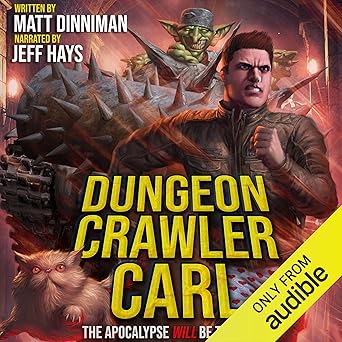
Review: Dungeon Crawler Carl

Dungeon Crawler Carl Cover Art

NEW ACHIEVEMENT: You found a book that sounds utterly ridiculous on paper and somehow turns out to be one of the most entertaining, emotionally effective, and unexpectedly addictive audiobooks you’ve listened to in years. Reward: existential dread, uncontrollable laughter, and a sudden urge to explain loot tables to confused friends.

Dungeon Crawler Carl by Matt Dinniman is an absolute riot from beginning to end. The premise feels like it was engineered in a laboratory to sound absurd. Earth is destroyed by an alien corporation, the survivors are forced into a galaxy wide reality television death game, and our protagonist must descend through an increasingly deadly dungeon accompanied by his ex-girlfriend’s prize-winning cat. It should be nonsense. In many ways it is nonsense. It is also brilliantly written, consistently hilarious, surprisingly brutal, and far more emotionally engaging than I ever expected.

At the centre of the chaos is Carl, who could easily have been written as a generic sarcastic action hero. Instead, he feels refreshingly human. He is bewildered, angry, frequently out of his depth, and often making decisions based on stubbornness and sheer survival instinct. His growing relationship with Princess Donut, who rapidly evolves from comic relief into one of the most entertaining characters in the book, becomes one of the novel’s greatest strengths. Their dynamic is genuinely funny, but it also develops real emotional depth as the story progresses.

What immediately stands out is how perfectly the book captures the feel of both MMORPGs and tabletop roleplaying games. Anyone who has spent far too many hours in World of Warcraft, Diablo, Final Fantasy XIV, or similar games will instantly recognise the mechanics. Loot drops, increasingly absurd item descriptions, skill trees, dungeon bosses, party management, crafting systems, min maxing, grinding, and wildly unbalanced encounters are all lovingly mocked while still feeling like genuine celebrations of gaming culture.

The tabletop influences are just as strong. There is a heavy Dungeons & Dragons energy running through the entire novel, particularly in the way absurd encounters can spiral into unexpected chaos because of player choices. It often feels like a dungeon master who has completely lost control of their campaign while the players somehow continue succeeding through luck, creativity, and reckless decision making. That chaotic energy gives the story an unpredictability that makes it incredibly difficult to stop listening.

What surprised me most was how dark the story becomes beneath the humour. The alien entertainment system at the heart of the dungeon is deeply disturbing, and Dinniman never lets the reader forget the human cost of the spectacle. Characters die horribly. People break under pressure. The satire of reality television and corporate exploitation becomes increasingly sharp as the story unfolds.

The audiobook is elevated to another level entirely by the phenomenal narration of Jeff Hays. This is genuinely one of the best audiobook performances I have ever heard. Hays does not simply narrate the story. He performs it with extraordinary energy, emotional range, and comedic precision.

His portrayal of Carl perfectly captures the character’s frustration, sarcasm, and vulnerability. More impressively, his performance as Princess Donut is extraordinary. He gives her a larger than life personality that could easily become irritating, yet somehow makes her endlessly entertaining. Her dramatic declarations are consistently hilarious.

Hays also handles the dungeon AI announcements, bizarre monsters, and enormous supporting cast with astonishing versatility. Every voice feels distinct and memorable. More importantly, he understands when to let the humour breathe and when to lean into the darker emotional moments. That balance is what makes the performance truly exceptional.

By the end, I was stunned by how much I loved this book. Dungeon Crawler Carl is clever, chaotic, heartfelt, and relentlessly entertaining. It embraces absurdity while delivering genuine stakes and surprisingly rich character development. Combined with Jeff Hays’ spectacular narration, this became one of the most enjoyable audiobook experiences I have had in a very long time.

Buy your copy here

Friday, 15 May 2026

Review: Logan's Run

Logan's Run Cover Art

Logan's Run by William F. Nolan remains a fascinating piece of science fiction that feels both unmistakably rooted in its era and surprisingly effective in its exploration of authoritarian control, youth obsession, and mortality. While many readers may know the story primarily through its film adaptation, returning to the original novel reveals a work that is often stranger, darker, and far more satirical than its cinematic counterpart.

The premise remains wonderfully compelling. In a future society where life is strictly capped at the age of twenty one, citizens live in a world built around endless pleasure, consumption, and carefully managed ignorance. Once individuals reach their expiration date, they are expected to submit willingly to death. Those who attempt to escape become "runners" and are hunted by Sandmen, elite enforcers tasked with preserving the system. Logan is one such Sandman, entirely committed to the world he serves until circumstances force him to question everything he has accepted as truth.

That central concept remains incredibly strong, and even decades after publication it still feels relevant. The novel explores society’s obsession with youth in ways that feel oddly prescient, and its portrayal of a culture built on distraction and indulgence carries an unsettling edge. Beneath the pulpy science fiction adventure lies a fairly sharp critique of conformity and the willingness of people to ignore uncomfortable truths when their own comfort is protected.

The story itself moves at an impressively fast pace. Logan’s journey takes him through a variety of strange environments and encounters, and the novel rarely pauses for long. At times this relentless momentum means certain characters and ideas are not explored as deeply as they could be, but it also gives the book a raw energy that makes it difficult to put down. There is a constant sense that the world is larger and stranger than Logan ever realised, which keeps the narrative engaging.

What stood out to me most was how imaginative the world building remains. Some elements feel very much like products of late 1960s science fiction, but there is a creativity to the settings, technologies, and social structures that remains entertaining. The novel embraces bold ideas with confidence, even when they occasionally border on the absurd.

The audiobook is elevated considerably by the narration of Oliver Wyman. Wyman delivers a performance filled with energy and emotional nuance that helps ground the novel’s more unusual concepts. His portrayal of Logan captures both his initial certainty and his growing confusion as his worldview begins to collapse.

Wyman’s pacing works particularly well with the novel’s rapid structure. He keeps the momentum high during action sequences while allowing quieter moments of reflection enough space to resonate. His character voices are distinct without feeling exaggerated, and he handles the shifting tones of satire, suspense, and introspection with real skill.

There is also an emotional sincerity to his narration that strengthens Logan’s personal journey. As the protagonist moves from loyal enforcer to questioning outsider, Wyman ensures that transformation feels believable.

Logan’s Run may occasionally show its age, but its inventive premise, relentless pacing, and underlying social commentary make it an enjoyable and thought provoking read. Combined with Oliver Wyman’s strong narration, this remains a highly entertaining science fiction classic that still has plenty to say.

Buy your copy here

Thursday, 14 May 2026

Review: Dragondrums

Dragondrums Cover Art
Dragondrums by Anne McCaffrey holds a particularly special place in my memory because it was the very first Dragonriders of Pern novel I ever read as a child. Long before I understood the wider chronology of the series or fully appreciated the depth of McCaffrey’s world building, this was my introduction to Pern. Revisiting it now as an adult carried a unique sense of nostalgia. I was returning not just to a novel, but to the doorway that first introduced me to one of my favourite fictional worlds.

That personal connection made the reread especially interesting because Dragondrums feels quite different when approached with adult eyes. As a child, I was immediately captivated by the dragons, fire lizards, Harper Hall politics, and the simple thrill of discovering a world that felt so vast and lived in. Those elements remain deeply enjoyable, but what stood out to me now was how thoughtful and character driven this novel really is.

Unlike Dragonsong and Dragonsinger, which focus on Menolly’s struggles to find acceptance and recognition, Dragondrums shifts its attention to Piemur. He had always been an entertaining supporting character in my childhood memory, largely because of his humour, confidence, and occasional talent for causing chaos. Revisiting the novel now, I found him far more layered than I remembered. His frustration over the loss of his singing voice feels genuinely painful, particularly because music had defined so much of his identity.

McCaffrey handles that transition exceptionally well. Piemur’s bitterness, embarrassment, and eventual adaptation all feel believable. He does not immediately embrace his new role, and his resentment is understandable. Watching him slowly realise that his talents extend far beyond singing creates a compelling emotional arc. His intelligence, curiosity, and ability to navigate difficult situations become increasingly important, and his growth feels earned rather than forced.

One of the most enjoyable aspects of the novel remains its sense of adventure. Piemur’s increasingly dangerous assignments and secretive tasks add momentum to the story, creating moments of tension that balance the more reflective character development. These sections remain highly entertaining and capture much of the excitement that first drew me into the series as a child.

The world building remains one of McCaffrey’s greatest strengths. By this point, Pern feels fully realised, with its social hierarchies, traditions, and evolving political tensions all contributing to the sense of a living world. Because this was my first introduction to Pern as a child, I remember feeling overwhelmed in the best possible way by how large everything seemed. Returning to it now, I was struck by how efficiently McCaffrey introduces these elements without overwhelming the reader.

The relationships between characters also feel richer than I remembered. Menolly remains a strong presence, and her friendship with Piemur adds warmth to the story. Their interactions feel genuine and supportive, helping ground the larger narrative in personal relationships.

The audiobook is significantly enhanced by the narration of Sally Darling. Darling once again proves herself an excellent match for this corner of the Pern universe. Her narration carries genuine warmth and emotional depth, particularly during Piemur’s more vulnerable moments.

She captures his frustration and insecurity with real sensitivity while also embracing his mischievous energy. That balance is essential to making Piemur as engaging as he is, and Darling handles it beautifully. Her performance ensures that his humour never undermines the more serious emotional beats.

Darling’s pacing is excellent throughout. She allows quieter moments of reflection to land while maintaining tension during the more adventurous sequences. Her character voices remain distinct without becoming exaggerated, helping preserve the grounded emotional tone of the novel.

Revisiting Dragondrums was both nostalgic and genuinely rewarding. There was a risk that the first Pern novel I ever read might feel diminished by time and memory, but the opposite proved true. The story remains engaging, emotionally honest, and full of charm.

While nostalgia certainly shaped my return to this book, it also reminded me why Anne McCaffrey’s world captured my imagination so completely as a child. Dragondrums remains a wonderful entry point into Pern and a deeply satisfying novel in its own right. With Sally Darling’s heartfelt narration adding even more emotional texture, this revisit felt like reconnecting with an old friend.

Buy your copy here

Sunday, 10 May 2026

Review: Dragonsinger

Dragonsinger Cover Art

Dragonsinger by Anne McCaffrey was one of those novels that lived vividly in my memory from childhood, even if many of the finer details had faded over time. Returning to it now for the first time in decades was both a nostalgic experience and an unexpectedly rewarding one. There is always a degree of risk when revisiting books that meant a great deal to you when you were younger. Sometimes they do not hold up in quite the way you hope. Thankfully, Dragonsinger not only survives that revisit, but in many ways feels richer and more emotionally resonant when read as an adult.

Picking up shortly after the events of Dragonsong, the novel follows Menolly as she leaves the restrictive environment of Half-Circle Sea Hold and begins life at Harper Hall. After spending so much of the previous book watching her talents be dismissed or actively suppressed, there is something deeply satisfying about seeing her enter a space where her musical gifts can finally be nurtured. That does not mean her journey suddenly becomes easy. McCaffrey wisely avoids making Harper Hall an idealised sanctuary, and Menolly quickly discovers that jealousy, hierarchy, and entrenched attitudes still create significant obstacles.

What makes the novel so effective is the way it balances external conflict with quieter emotional development. The dramatic tension here is far less about life threatening danger and more about belonging, confidence, and self worth. Menolly remains an immensely likeable protagonist because she never transforms into an effortlessly confident hero. She continues to doubt herself, struggles with loneliness, and often feels overwhelmed by the expectations placed upon her. Those insecurities make her triumphs feel genuinely earned.

Revisiting the novel as an adult, I found myself appreciating these emotional beats far more than I did as a child. When I first read Dragonsinger, I was naturally drawn to the fire lizards, the music, and the wider sense of adventure. Those aspects remain delightful. The fire lizards are still wonderfully charming, often providing moments of humour and warmth, and McCaffrey’s descriptions of music retain a sense of passion that makes Menolly’s gift feel tangible.

What stood out much more this time was the social complexity of Harper Hall. The rivalries between apprentices, the insecurities of those who feel threatened by Menolly’s talent, and the institutional traditions that shape behaviour all feel more nuanced than I remembered. McCaffrey does an excellent job of portraying how progress often happens unevenly. Menolly may have escaped one form of restriction, but she still has to navigate people who are resistant to change.

The world of Pern continues to feel wonderfully immersive. One of McCaffrey’s greatest strengths has always been making the setting feel lived in. The halls, holds, and traditions all possess a sense of history, and even smaller moments help reinforce that depth. Dragonsinger may be more intimate in scale than some of the larger Pern novels, but that narrower focus allows the world building to feel particularly personal.

The audiobook is elevated significantly by the narration of Sally Darling. Darling delivers a wonderfully warm and emotionally intelligent performance that feels perfectly suited to Menolly’s story. Her narration captures the protagonist’s vulnerability without ever making her seem weak, and she handles moments of triumph with genuine warmth.

There is a real emotional sensitivity in Darling’s performance that strengthens the quieter scenes. Moments of embarrassment, isolation, and joy all feel authentic because she allows them space to breathe. Her portrayal of supporting characters is equally effective, creating clear distinctions without becoming exaggerated or theatrical.

Her pacing is particularly strong during scenes involving music. She manages to communicate the emotional importance of these moments in a way that feels natural and heartfelt. That is no small achievement in a story where music is so central to the protagonist’s identity.

Returning to Dragonsinger after so many years reminded me why Anne McCaffrey’s work left such a lasting impression on me as a child. It remains a thoughtful, heartfelt coming of age story wrapped in a richly realised fantasy world. While nostalgia certainly played a role in my enjoyment, the novel’s emotional honesty and enduring charm proved that my childhood affection for it was entirely deserved. Combined with Sally Darling’s excellent narration, this was a genuinely rewarding revisit.

Buy your copy here

Thursday, 7 May 2026

Review: Dragonsong

Dragonsong Cover Art

Dragonsong by Anne McCaffrey was one of those formative books I encountered as a child, the kind of novel that quietly embeds itself in your imagination and remains there for decades. Returning to it now for the first time since childhood was a fascinating experience, not simply because of nostalgia, but because I found myself responding to the story in very different ways as an adult. What once felt like a straightforward tale of adventure and self discovery now reveals deeper themes about autonomy, gender expectations, and resilience that I simply did not have the perspective to fully appreciate when I first read it.

The story follows Menolly, a gifted young woman living in a small fishing hold on Pern, where her musical talent is dismissed and actively suppressed because of rigid social expectations surrounding what women should and should not do. After an injury threatens her ability to play music and her family continues to stifle her ambitions, Menolly flees and carves out a life for herself in isolation, eventually forming a remarkable bond with a group of fire lizards.

As a child, I remember being captivated by the dragons, the fire lizards, and Menolly’s independence. Those elements remain every bit as compelling today. McCaffrey’s world building is as immersive as ever, and Pern still feels wonderfully unique in the way it blends science fiction foundations with the aesthetics of fantasy. The natural ecosystem, social structures, and traditions all feel lived in, and Dragonsong serves as a particularly effective entry point into that wider world.

What struck me far more on this reread, however, were the themes of patriarchy and misogyny that shape Menolly’s life. As a child, I understood that she was being treated unfairly, but I lacked the life experience to fully appreciate how insidious those attitudes were. Reading it as an adult, the restrictions placed on her feel far more frustrating and sadly recognisable. Her father’s rigid beliefs, her mother’s internalised acceptance of those beliefs, and the wider social norms of her community create an environment that feels suffocatingly believable.

What makes the novel so effective is that McCaffrey never allows these themes to overwhelm the sense of wonder at the heart of the story. Menolly’s struggle is painful, but it is also deeply empowering. Her journey towards self worth feels earned because it emerges through perseverance rather than sudden transformation. She remains vulnerable, frightened, and uncertain throughout much of the story, which makes her eventual growth all the more satisfying.

The emotional heart of the audiobook is strengthened enormously by the narration of Sally Darling. Darling delivers a performance filled with warmth and emotional nuance that perfectly suits Menolly’s story. Her narration captures the protagonist’s vulnerability during moments of rejection and loneliness, while also conveying her growing confidence as she begins to recognise her own worth.

Darling’s performance is especially effective in scenes involving Menolly’s music. She communicates the emotional significance of these moments with genuine tenderness, helping the listener understand why music means so much to the character. Her pacing allows quieter emotional beats to land effectively, and she handles the wider cast with clarity and subtle distinction.

There is also a sincerity to Darling’s narration that complements the novel’s emotional core. She never overplays dramatic moments, instead allowing the feelings already present in McCaffrey’s writing to emerge naturally. That restraint makes the audiobook feel deeply intimate.

Revisiting Dragonsong after so many years could easily have been disappointing. Childhood favourites do not always survive adult scrutiny. Instead, I found a richer and more emotionally layered story than I remembered. The adventure remains delightful, the world of Pern remains captivating, and Menolly remains an inspiring protagonist.

What changed was my understanding of the themes beneath the surface, and that only deepened my appreciation. Combined with Sally Darling’s heartfelt narration, Dragonsong proved to be both a nostalgic return and a genuinely rewarding new experience. It remains a deserved classic and one of Anne McCaffrey’s most enduringly powerful works.

Buy your copy here

Monday, 4 May 2026

Review: The Trouble with Peace

The Trouble with Peace Cover Art

The Trouble with Peace by Joe Abercrombie takes everything that made A Little Hatred such a strong return to the First Law universe and sharpens it into something even more compelling. As the second instalment in the Age of Madness trilogy, it deepens the political tensions, expands the emotional stakes, and drives its characters toward choices that feel both inevitable and devastating.

One of Abercrombie’s greatest strengths has always been his ability to juggle multiple storylines without losing momentum, and that talent is on full display here. The narrative moves between political intrigue, social unrest, personal ambition, and military conflict with remarkable confidence. What could easily feel sprawling instead feels carefully orchestrated. Every thread contributes to a broader picture of a world straining under the pressure of rapid industrial and social change.

The depth of the story is particularly impressive. This is not simply a tale of kingdoms at war or rival factions competing for power. Abercrombie explores the fragility of institutions and the ways in which systems built on exploitation eventually begin to fracture. Economic inequality, class resentment, and the corrosive influence of unchecked ambition all play major roles in shaping the events of the novel. These themes give the story a weight that extends beyond its immediate conflicts.

At the heart of the novel, however, are the themes of loyalty and betrayal. Nearly every major character is forced to confront conflicting obligations. Loyalty to family, loyalty to nation, loyalty to ideals, and loyalty to personal ambition frequently pull people in opposing directions. These tensions create some of the novel’s most powerful moments because there are rarely simple moral choices.

Betrayal is equally central, and Abercrombie handles it with characteristic nuance. Some betrayals are shocking and dramatic, while others are quieter and perhaps more painful because they emerge from understandable motivations. Characters betray others out of fear, ambition, self preservation, and even misguided affection. These acts rarely feel arbitrary. Instead, they grow naturally from the personalities and circumstances involved, making their consequences all the more effective.

The character work remains exceptional. Savine dan Glokta continues to be one of the most fascinating figures in the series, balancing intelligence, ruthlessness, and vulnerability in equal measure. Leo dan Brock’s arc is equally compelling as his idealism collides with harsh realities. Orso remains one of Abercrombie’s most unexpectedly sympathetic creations, using humour and apparent laziness to mask deeper insecurities and strengths. Across the board, the cast feels layered and deeply human.

Abercrombie’s dialogue remains as sharp as ever. Conversations are filled with dry wit, tension, and unspoken motives. Even relatively quiet scenes can feel gripping because so much is happening beneath the surface. The humour provides balance to the darker elements of the story without undermining the emotional stakes.

The audiobook is once again elevated by the remarkable narration of Steven Pacey. Pacey continues to prove that he is one of the finest narrators working in fantasy audiobooks. His understanding of Abercrombie’s world and characters is evident in every scene.

His ability to differentiate such a large cast remains extraordinary. Each character feels instantly recognisable through subtle vocal shifts, and those distinctions become even more important in a story filled with political conversations and shifting alliances. Pacey ensures that listeners can follow every exchange with ease.

What makes his performance particularly impressive is his emotional range. He captures Orso’s dry humour, Savine’s steel, Leo’s frustration, and the quiet menace of other key figures with equal skill. During moments of betrayal and emotional upheaval, his delivery adds even greater impact without becoming exaggerated.

Pacing is another major strength of his narration. He allows quieter scenes to breathe while maintaining urgency during moments of conflict. This balance mirrors the structure of the novel itself, which alternates between intimate character moments and sweeping political developments.

One of the most satisfying aspects of The Trouble with Peace is how effectively it builds anticipation for the final instalment. Major events reshape the world in dramatic ways, yet the novel still feels complete in its own right. It delivers meaningful character development and substantial narrative progression while leaving enough unresolved tension to make the next book feel essential.

Overall, The Trouble with Peace is a rich, intelligent, and emotionally charged continuation of the Age of Madness trilogy. Its exploration of loyalty and betrayal gives the story tremendous emotional force, while its political depth and exceptional character work make it consistently engaging. Combined with Steven Pacey’s outstanding narration, this is an audiobook experience that is difficult to pause and even harder to forget.

Buy your copy here