Showing posts with label Sci-fi-Dystopia. Show all posts

Friday, 15 May 2026

Review: Logan's Run

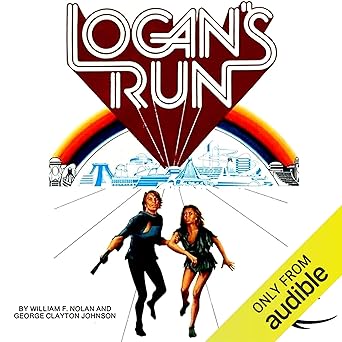
Logan's Run Cover Art

Logan's Run by William F. Nolan remains a fascinating piece of science fiction that feels both unmistakably rooted in its era and surprisingly effective in its exploration of authoritarian control, youth obsession, and mortality. While many readers may know the story primarily through its film adaptation, returning to the original novel reveals a work that is often stranger, darker, and far more satirical than its cinematic counterpart.

The premise remains wonderfully compelling. In a future society where life is strictly capped at the age of twenty one, citizens live in a world built around endless pleasure, consumption, and carefully managed ignorance. Once individuals reach their expiration date, they are expected to submit willingly to death. Those who attempt to escape become "runners" and are hunted by Sandmen, elite enforcers tasked with preserving the system. Logan is one such Sandman, entirely committed to the world he serves until circumstances force him to question everything he has accepted as truth.

That central concept remains incredibly strong, and even decades after publication it still feels relevant. The novel explores society’s obsession with youth in ways that feel oddly prescient, and its portrayal of a culture built on distraction and indulgence carries an unsettling edge. Beneath the pulpy science fiction adventure lies a fairly sharp critique of conformity and the willingness of people to ignore uncomfortable truths when their own comfort is protected.

The story itself moves at an impressively fast pace. Logan’s journey takes him through a variety of strange environments and encounters, and the novel rarely pauses for long. At times this relentless momentum means certain characters and ideas are not explored as deeply as they could be, but it also gives the book a raw energy that makes it difficult to put down. There is a constant sense that the world is larger and stranger than Logan ever realised, which keeps the narrative engaging.

What stood out to me most was how imaginative the world building remains. Some elements feel very much like products of late 1960s science fiction, but there is a creativity to the settings, technologies, and social structures that remains entertaining. The novel embraces bold ideas with confidence, even when they occasionally border on the absurd.

The audiobook is elevated considerably by the narration of Oliver Wyman. Wyman delivers a performance filled with energy and emotional nuance that helps ground the novel’s more unusual concepts. His portrayal of Logan captures both his initial certainty and his growing confusion as his worldview begins to collapse.

Wyman’s pacing works particularly well with the novel’s rapid structure. He keeps the momentum high during action sequences while allowing quieter moments of reflection enough space to resonate. His character voices are distinct without feeling exaggerated, and he handles the shifting tones of satire, suspense, and introspection with real skill.

There is also an emotional sincerity to his narration that strengthens Logan’s personal journey. As the protagonist moves from loyal enforcer to questioning outsider, Wyman ensures that transformation feels believable.

Logan’s Run may occasionally show its age, but its inventive premise, relentless pacing, and underlying social commentary make it an enjoyable and thought provoking read. Combined with Oliver Wyman’s strong narration, this remains a highly entertaining science fiction classic that still has plenty to say.

Buy your copy here

Saturday, 4 April 2026

Review: The Fireman

The Fireman Cover Art

The Fireman by Joe Hill is a bold, emotionally resonant, and often unsettling novel that blends apocalyptic horror with deeply human storytelling. It takes a high concept premise and grounds it in character, relationships, and the fragile structures that hold society together. The result is a work that feels both expansive in scope and intimate in its emotional focus.

The story centres on a global pandemic known as Dragonscale, a fungal infection that causes those afflicted to spontaneously combust. It is a striking and memorable idea, one that allows Hill to explore themes of fear, control, and the breakdown of order. As the infection spreads, society fractures in ways that feel disturbingly plausible. Communities turn inward, paranoia grows, and the line between survival and cruelty becomes increasingly blurred.

At the heart of the novel is Harper Grayson, a nurse who finds herself infected and pregnant as the world begins to collapse around her. Harper is an engaging and sympathetic protagonist, defined by her compassion and resilience. She is not immune to fear or doubt, but she continues to act with a sense of purpose that makes her easy to root for. Through her perspective, Hill explores the emotional toll of the apocalypse, focusing not just on survival but on what it means to remain humane in the face of overwhelming adversity.

The figure of the Fireman himself adds a mythic quality to the narrative. As a character, he embodies both danger and hope, reflecting the dual nature of the Dragonscale infection. Hill uses him to explore the idea that even the most destructive forces can be understood and, perhaps, controlled. This tension between destruction and possibility runs throughout the novel and gives it much of its thematic weight.

Hill’s prose is one of the book’s greatest strengths. His writing is vivid and evocative, capable of capturing both the horror of the situation and the quieter, more reflective moments that give the story its emotional depth. There are passages that feel almost lyrical, particularly when Hill reflects on memory, family, and the persistence of culture even as the world falls apart.

It is in these moments that readers may notice the influence of Stephen King, Hill’s father. The novel contains several poignant echoes of King’s work, not in a derivative sense but as a kind of literary conversation. Themes of community under pressure, the endurance of ordinary people, and the intrusion of the extraordinary into everyday life all feel like a continuation of that tradition. These references add a layer of richness for readers familiar with King’s writing, creating a sense of continuity between generations of storytelling.At times, however, the novel includes references that feel slightly less integrated.

Mentions of J. K. Rowling and her work can come across as somewhat jarring due to her continued ranting about trans issues. While they reflect the cultural landscape in which the story is set, they occasionally pull the reader out of the narrative rather than enhancing it. This is a minor issue in the context of the broader novel, but it stands out precisely because so much else feels carefully constructed and immersive.

The audiobook adaptation is elevated significantly by the narration of Kate Mulgrew. Mulgrew delivers a performance that is both powerful and nuanced, capturing the emotional complexity of the story with impressive skill. Her voice conveys Harper’s vulnerability and determination, making the character’s journey feel immediate and personal.

Mulgrew’s pacing is particularly effective. She allows scenes to breathe when necessary, giving weight to moments of reflection and emotional connection. At the same time, she builds tension expertly during scenes of danger or conflict. Her ability to shift between these modes ensures that the narrative remains engaging throughout its considerable length.

Another strength of Mulgrew’s narration is her character work. She differentiates the various voices in the story with clarity and subtlety, avoiding caricature while still giving each character a distinct presence. This is especially important in a novel that features a wide range of personalities and perspectives. Mulgrew’s performance helps bring these characters to life in a way that enhances the emotional impact of the story.

Ultimately, The Fireman succeeds because it is more than just an apocalyptic thriller. It is a story about community, resilience, and the enduring power of hope. Hill takes a terrifying premise and uses it to explore what people are capable of when the world falls apart, both for better and for worse.

With its rich prose, compelling characters, and strong thematic core, the novel stands as one of Hill’s most accomplished works. Kate Mulgrew’s outstanding narration adds an additional layer of depth, making the audiobook a particularly rewarding experience. Despite a few minor tonal inconsistencies, this is a gripping and often moving story that lingers in the mind long after it has ended.

Buy your copy here